

Author: Tetyana Buturlakina, career counselor, Head of the Career Center of UzhNU, Ass. Prof., Ph.D. in Economics, ambassador of the National Center for Europass and Euroguidance in Ukraine in the area of "Career counseling for integration into the modern labor market: skills development in priority sectors of the economy".
The current dynamics and globalization of the labor market require a review of approaches to assessing the level of qualifications, competencies and skills. Specialists change jobs and employers more often than in the past, the need for new skills regularly arises, and geographical and professional mobility is increasing. Online services and platforms are changing the methods and algorithms of recruitment. Employers and job seekers use digital tools to publish and apply for jobs or to find and offer training opportunities. Companies and education providers need clear and up-to-date information on skills and qualifications to better manage talent and close skills gaps in education and training programs.
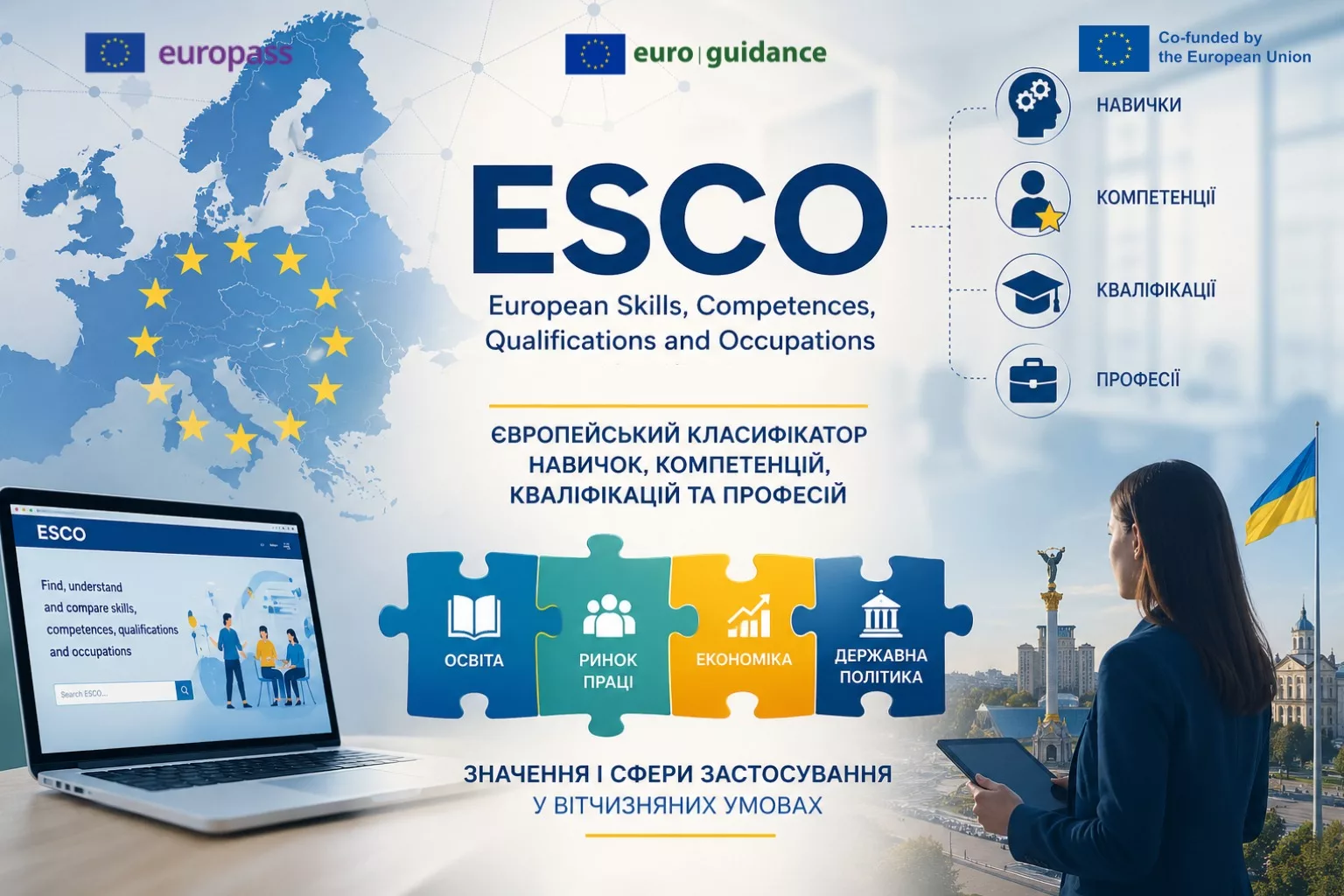
The need for a unified approach in modern conditions has led to the consideration and integration of the international standard - ESCO (European Skills, Competences, Qualifications and Occupations) European multilingual classifier of skills, competences, qualifications and occupations. ESCO functions as a reference that describes, identifies and classifies occupations and skills relevant to the EU labor market, as well as education and training.
ESCO provides a description of 2942 occupations and 13 485 skills related to these occupations, translated into 27 languages (all official EU languages plus Icelandic, Norwegian and Arabic).
ESCO Classification
The Occupations Pillar is one of the two pillars of ESCO, which organizes occupational concepts, uses hierarchical relationships between them, metadata, and mapping to the International Standard Classification of Occupations (ISCO) to structure occupations.
The Skills and Competences Pillar of ESCO distinguishes between: (1) concepts of skills/competences and (2) concepts of knowledge, indicating the type of skills, but there is no distinction between skills and competences - each of these concepts has one preferred term and a number of undesirable terms in each of the 28 ESCO languages, and each concept also contains an explanation in the form of a description.
Qualifications are the formal outcome of an assessment and validation process, which is obtained when a competent authority determines that an individual has achieved learning outcomes in accordance with specified standards. Information on qualifications at European level is now reflected in Europass and comes from national qualifications databases reflecting the National Qualifications Frameworks owned and managed by the EU Member States and Europass.
What are the application areas of ESCO?
ESCO is used in online services and platforms: ESCO concepts and their connections can be understood through electronic systems, allowing different systems and platforms to use ESCO to offer the most relevant vacancies to job seekers based on their skills or the most relevant training to people who want to retrain or upgrade their skills.
ESCO connects people and jobs: ESCO contains accurate descriptions of occupations and skills that can be used both for job offers and resumes, facilitating comparison and matching - helping both employers find the right people for their vacancies and job seekers find the right vacancy according to their skills.
ESCO connects employment with education:: using ESCO in job offers, research, big data analysis, etc. helps education and training providers understand what skills are relevant in the labor market in order to adapt curricula, improve the quality of students' training to real labor market requirements; in turn, ESCO also helps potential employers better understand and assess the level of training of students and graduates.
ESCO connects labor markets and promotes mobility: ESCO is available in 28 languages, allowing jobseekers and employers to better communicate about skills, training and vacancies in any European language of their choice. Through its use on the portal of the EU-wide network of employment services (European Employment Services - EURES) and many other online platforms, ESCO helps European public and private employment services to offer their services across borders, languages and electronic systems, so that they can better support people who want to work in another European country.
In accordance with the above advantages of the classifier, Europass also uses the integrated ESCO service as follows:
1) Europass users, when filling out their profile in the "Work experience" section, are offered a specific list of occupation from which they can select professions and positions for their profile or CV;
2) ESCO also provides full descriptions of occupation, which reveal details by skills and competences of the field of employment, in the "Learn more" detail option it directs to all information about a specific profession.
ESCO concepts and descriptions can help to understand:
what knowledge and skills are typically required to work in a particular occupation;
what knowledge, skills and competences are acquired as a result of obtaining a particular qualification;
what qualifications are required or frequently requested by employers from those seeking employment in a particular occupation.
The use of ESCO concepts also contributes to the transition to an ever-growing digital labor market by offering a common “language” of occupations and skills that allows these digital tools to better communicate and work together.
However, despite the unification and standardization of the requirements of the classifier, ESCO needs continuous improvement to remain an added value for the labor market and education and training systems, as employers regularly request new occupations and skills, and changes in curricula and terminology are also regularly introduced into education and training programs. To take into account these changes, it is important to frequently share feedback, suggestions and ideas for improving the content and management of the classification with organizations using ESCO and other stakeholders.
USEFUL RESOURCE:
European Skills, Competences, Qualifications and Occupations (ESCO): https://esco.ec.europa.eu/
 Back
Back